
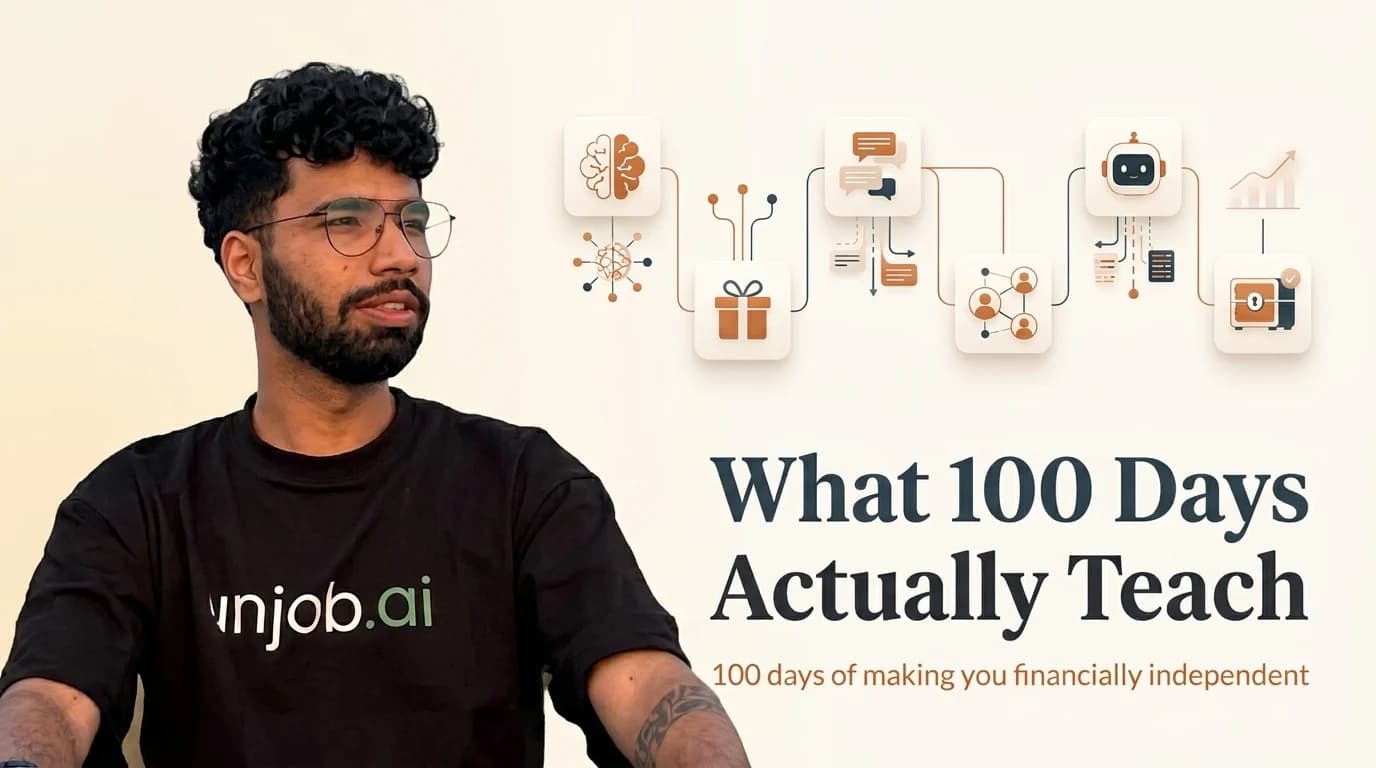
What 100 Days of Making You Financially Independent Actually Teaches
Dev's 100 Days of Making You Financially Independent is easy to mistake for a series built on motivation, hooks, and internet energy. But when you step back and look across the transcripts, a much clearer pattern appears.
This series is really about economic agency.
It keeps pushing one core belief from different angles. Financial independence does not start with prestige, perfect planning, or endless preparation. It starts when someone learns a useful skill, turns it into an offer, finds attention, and gets comfortable asking the market for money.
That is what gives the whole series its shape.
Pillar 1: Skills matter only when they become offers
Across the transcripts, the series does not glorify learning for the sake of learning. Again and again, the message is simple. A skill is only useful when people can understand what it does for them.
That is why the series keeps returning to practical, saleable skills such as AI automation, video editing, web development, content support, design, and digital services. But the deeper lesson is not about the list. It is about packaging.
The market rarely pays for vague talent. It pays for clear outcomes. The person who says "I can help you produce short form videos for your brand" will always be easier to hire than the person who says "I can do a bit of everything."
That shift from skill to offer is one of the clearest repeated ideas in the series.
Pillar 2: Content is treated as a business tool
This series does not talk about content the way most creator advice does. Content is not presented as self expression first. It is presented as distribution.
In this framing, content helps people get discovered, build trust, create proof, and attract clients or opportunities without having to pitch from zero every single time. Followers and views matter here, but not because fame is the goal. They matter because visibility lowers friction.
In that sense, the content advice keeps functioning as business advice. The goal is not only expression. The goal is visibility, proof, and demand generation.
For freelancers, founders, and ambitious students, the message is clear. If nobody knows what you do, your skill stays invisible. Content is one way to fix that.
Pillar 3: Freelancing is the fastest path to first cash flow
If the series has one clear economic engine, it is freelancing.
Across the run, the advice keeps coming back to cold outreach, messaging templates, client positioning, premium offers, platform discovery, follow-ups, and closing mistakes. The pattern is consistent. If someone wants to make money before a larger business takes shape, service work is the shortest bridge between skill and income.
It does not pretend that money appears just because someone is talented. It keeps pointing back to uncomfortable actions like reaching out, hearing no, improving the pitch, following up, and staying in the game long enough to earn trust.
That is why freelancing keeps appearing as the practical training ground in the series.
Pillar 4: AI is leverage, not the whole plan
AI shows up all through the series, but the most useful part is how it is framed.
It is not presented as magic. It is presented as leverage.
The underlying promise is that AI can help people move faster, learn quicker, build deliverables without a large team, test ideas cheaply, and improve the quality of what they sell. Whether the topic is AI agents, content tools, no code products, app builders, or prompt driven workflows, the larger point stays the same.
AI keeps showing up as a way to compress time, reduce cost, and expand what one person can deliver.
That is why AI in this series works best when it sits on top of skill, sales, and distribution. It is not the career by itself. It is the multiplier.
Pillar 5: Financial independence is also about optionality
The series talks a lot about earning, but it is not only about earning more.
It also keeps coming back to saving money, avoiding bad financial habits, building some level of safety, being careful with reckless speculation, and thinking more seriously about how income changes life choices.
That makes the bigger message stronger. Financial independence here is not just about bigger numbers. It is about having more room to choose. The ability to say no, experiment, take a risk, start something, or move without constant panic is part of the goal too.
That is the repeated shape of the money advice across the series.
Pillar 6: Underneath everything, the series teaches business thinking
Even when an episode looks like a quick tip, a website recommendation, or a strong opinion, a lot of the series is quietly teaching people how to think commercially.
It pushes viewers to notice profitable niches, evaluate ideas, think in offers, understand clients, care about margins, and look at ordinary businesses with sharper eyes. In that sense, the series is not only trying to help people make money. It is trying to make them more useful to the market.
Put together, those episodes keep teaching how value gets created, packaged, sold, and scaled.
Final Takeaway
The lasting value of 100 Days of Making You Financially Independent is not that it offers one hundred separate tricks.
Its value is that it builds a worldview.
Learn something useful. Turn it into an offer. Put it in front of people. Use content to build trust. Use AI to move faster. Treat freelancing as training in real market behavior. Save enough money to create breathing room. Think like someone who can build value, not just consume advice.
That is what this series is really teaching.
How I Approached the Analysis
To study the 100 day run properly, I treated it as one connected body of work rather than a collection of isolated reels.
The process was simple. I first collected the series data with OpenCLI, which gave me a structured way to work with the Instagram feed. I am also an active contributor to the project, and it has been one of the most useful open source tools in my browser automation workflow.
Since Instagram does not provide a clean transcript layer for this kind of study, I then downloaded the reels locally using yt-dlp. From there, I generated transcripts with faster-whisper using the large-v3 model with Hindi-first settings to better handle the bilingual nature of the series.
Once the source material was ready, the final step was synthesis. I reviewed the full run for recurring ideas, repeated advice, business patterns, and practical themes, then used Codex 5.5 to shape those findings into a single readable essay.